Estate Data-to-Decisions
Education estates · UK · multi-academy trusts
One data-driven view of a school estate across compliance, assets, energy, and carbon.
Context
A school estate has to evidence compliance across 22 separate UK statutory regimes, maintain an asset base with real lifecycle risk, and account for energy and carbon — and most do it in spreadsheets. For a trust running several schools, there was no shared view, so estate health could not be compared and capital planning came down to argument rather than data.
- Statutory evidence lived in spreadsheets and inboxes, so audit packs were assembled from scratch
- Asset condition and lifecycle were tracked separately from any maintenance plan
- Energy consumption arrived as monthly bills, far too late to change behaviour
- Decarbonisation cases could not be appraised without consistent baseline data
Outcome
- Audit packs stopped being rebuilt from scratch each cycle
- Consumption became visible early enough to act on rather than after billing
- PLACEHOLDER — add a measured figure here (e.g. energy cost or carbon reduction across a pilot trust, with the window)
What we built
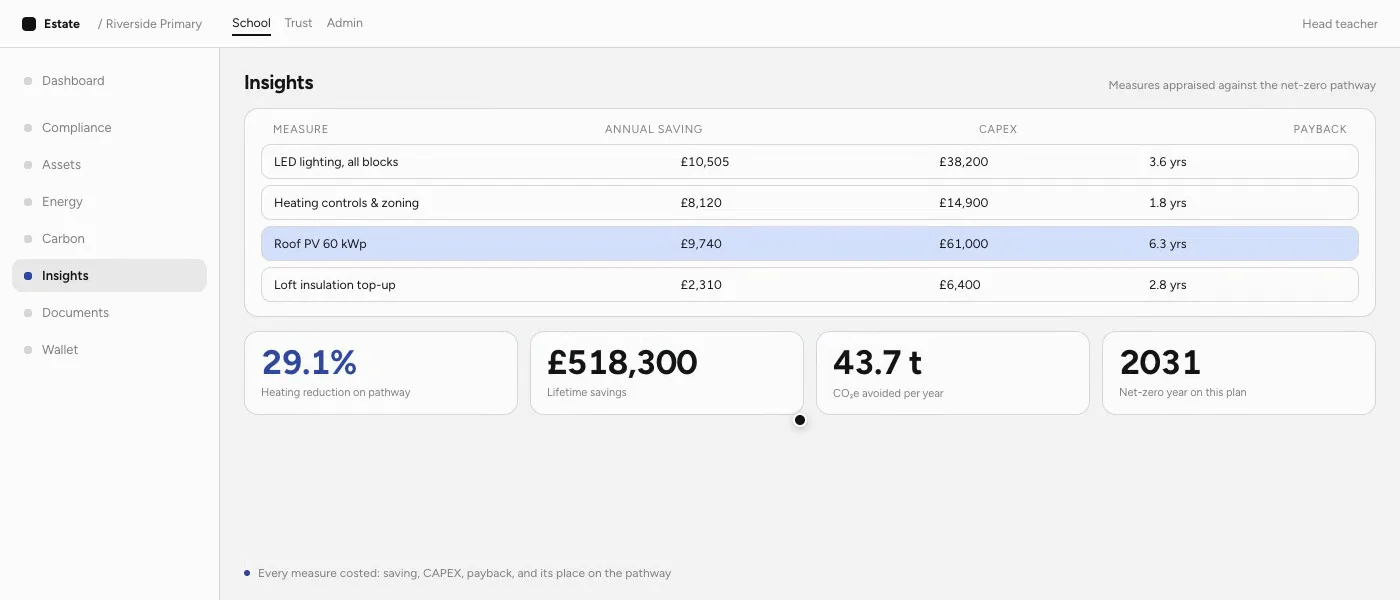
A multi-tenant platform over 43 tables, with the four pillars as first-class surfaces: statutory compliance with an evidence trail and audit pack, an asset register carrying condition and lifecycle across 22 categories, energy oversight, and decarbonisation appraisal with CAPEX and payback.
Data arrives three ways so nobody is blocked on the hardest one: scheduled API sync from per-school meter connectors, operational records captured in the app, and bulk import from the spreadsheets being replaced. Connector credentials are held per school in Supabase Vault rather than in config.
Five persona dashboards — leadership, finance, operations, governance, wellbeing — because a finance director and a site manager need different answers from the same estate. A trust-wide picker scores estate health so schools can be compared at a glance.
A savings wallet tracks the refundable performance commitment, which makes the commercial promise auditable inside the product rather than in a side agreement.
What stuck
- Compliance evidence accumulates continuously instead of being assembled before an audit
- Capital planning arguments are settled against condition and consumption data
- Adding a school is configuration, not a new spreadsheet
Snapshot
- Client profile
- Education estates SaaS for UK schools and multi-academy trusts
- Engagement
- Catalyst — multi-tenant platform build
- Timeline
- ~10 months
- Scope
- Statutory compliance, asset and planned maintenance, energy oversight, decarbonisation
- Scale
- 43 tables, 22 statutory regimes, 22 asset categories, 5 persona dashboards